
Narrowing the Search
Following the previous flight (Google & Google Scholar), my search was reconfigured to serve two destination questions, of which, Question Two will be the priority:
What are the possible challenges encountered by teachers or students when implementing inquiry learning in the primary school classroom?
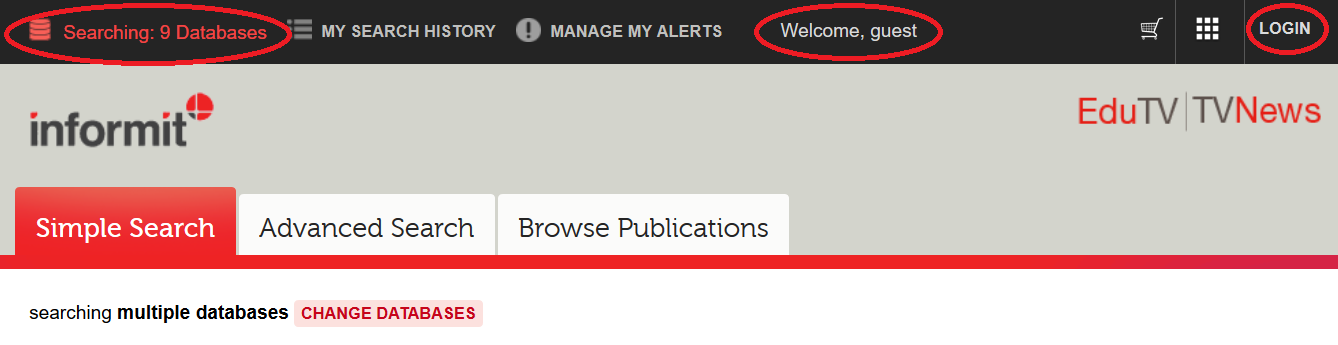
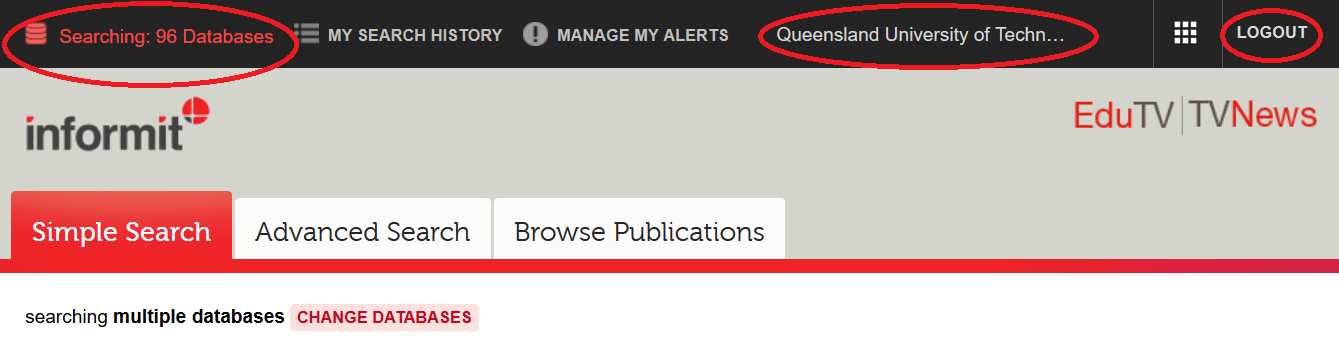
(Above) Image 4.1. Screen cap: Guest access (9 databases). | | (Above) Image 4.2. Screen cap of member access (96 databases).
Accessing the A+ Education database was challenging. Informat allows member and guest access to its databases. I was not aware that select databases (only 9) are available to guests, whilst member can access 96, one of which is A+ Education. Without full service access, search results are limited. Remember to login!
New Terminology
As evident on the previous flight, inquiry learning has many different names. I used proximity [!3] to search results where ‘inquiry’ was within three words of ‘learning’, and a wildcard [?] to capture all spelling variations:
The following two string returned the same results (except one) suggesting teachers and students are intrinsically linked and separate searches are unhelpful.
Thesaurus
Because of the many interpretations of inquiry learning, I needed help narrowing the search. Enter Thesaurus, a means of indexing and cataloguing data. Only every database has a different thesaurus.
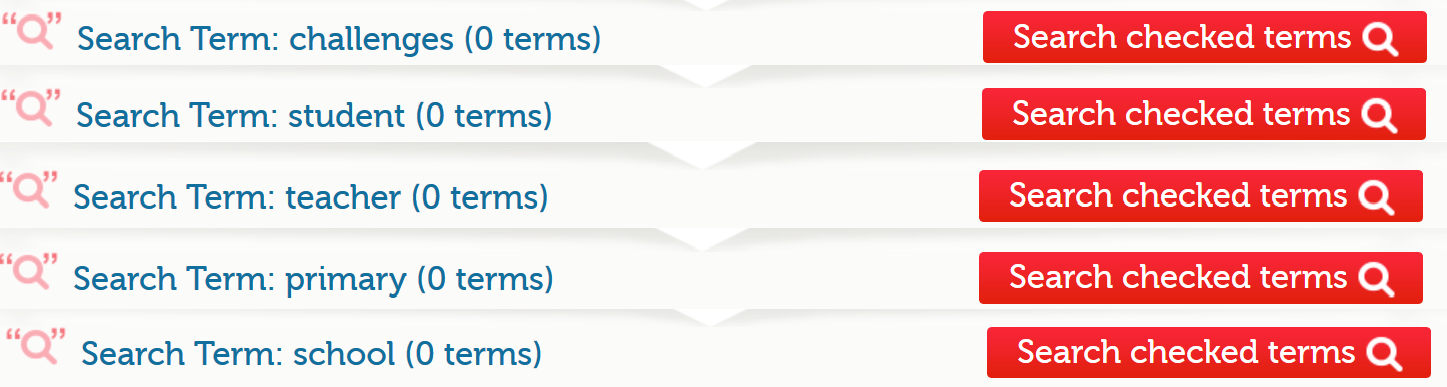 (Above) Image 4.3. A+ Education thesaurus results for various search terms.
Student, teacher, primary and school returned no entries (above), which seemed odd. So I manually browsed the thesaurus.
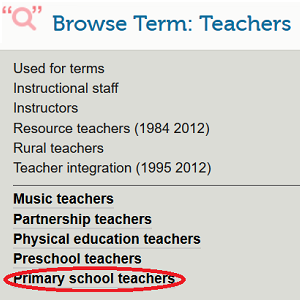 (Left) Image 4.4. Screen cap showing thesaurus entry for ‘Teachers’ and sub-divisions.
Low and behold, teachers (plural) was there!
I now knew two things:
1. thesaurus does not search for variations
2. sometimes a manual search is necessary
Under Teachers, this thesaurus divided into types. I focused my search on primary school teachers.
The above change in altitude prompted a new question:
What role can inquiry learning play in a multi-aged/multi-staged classroom?
Check out the super nerdy A+ Education searches here. Top three searches, highlighting the importance of using the thesaurus and subject headings:
Databases can use unexpected terminology (e.g. participation instead of engagement). By using A+ Education’s thesaurus you can narrow search criteria by pre-defined subject headings. Thesaurus searches must be exact, otherwise a manual search (through A-Z) will reveal suitable and similar topics to search by. Results produce a mixture of free-to-view and paywall articles. A+ Education is flying Premium Economy: You pay a little extra, but membership gets you access to an exclusive area, with the functionality of economy, but the results of business.
– – – – – – – – – –