
As part of my teacher-librarian studies, I have designed a Unit of Work around the Guided Inquiry Design model, and other frameworks. This is a brief overview of the unit.
Are we wasting our waste?
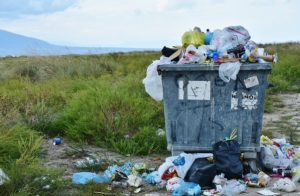 Image Attribute: Garbage. RitaE. 2017. Sourced from Pixabay. CC license.
According to the Australian Bureau of Statistics (2013), in 2010 Australian households produced approximately 12.4-million tonnes of waste annually. As our population increases, so will our waste. Whether we as individuals make small changes to our waste habits, or those in power make more dramatic policy changes, something needs to be done sooner, rather than later, if we are to reduce the human impact on our environments.
“Living sustainably means living within the capacity of the natural environment to support life and ensuring our current lifestyle has minimal impact on generations to come. Sustainable practices relate not only to the natural environment, but also our society and culture, including aspects such as consumerism and community well-being.”
– Rhonda Livingstone, 2016
Unit Context
Salvaging Our Waste is a Stage 2 (Year 4) Geography unit focusing on the Earth’s Environment from the NSW K-10 Geography syllabus. However, other key learning areas can be integrated into the unit if stage planning allows for this. Curriculum content to consider:
- English (persuasive texts)
- Mathematics (statistics and probability)
- PDHPE (personal choices)
- Science (material world, living world)
- Creative Arts* (Visual Arts, Drama, Dance, Music). *depending on student choice for assessment
Working collaboratively is a core aspect of inquiry learning, and this starts from the development stage. Ideally, you should work with the teacher librarian and at least one other expert to implement the unit, as each expert brings their own knowledge and perspective (Kuhlthau, Maniotes, Caspari. 2012). Acting as the “curriculum content expert” you need to collaborate with at least the teacher librarian, who will be your expert in “information literacy, resources and technology” (Kuhlthau, Maniotes, Caspari, 2012). This unit also invites local community members to act as experts, so consider inviting them into the process early and incorporating their knowledge.
“Young children have the greatest stake as citizens in the future.”
– European Panel on Sustainable Development, 2010
Intended Learning Outcomes
Salvaging Our Waste has been divided into two mini-units – Get Ready and Take Action. Get Ready focuses on the inquiry learning behind waste management strategies and sustainable practices, whilst Take Action encourages social action and change. The two mini-units work to support students achievement of the Stage 2 NSW K-10 Geography outcomes.
During Get Ready students will:
- focus on household physical waste and sustainable practices as a means to protect the environment
- investigate sustainable practices, current local waste management policies and environmental projects
- interview experts about sustainable practices and environmental impact
- consider how their waste can be managed sustainably by applying the three ‘R’s – reduce, reuse, recycle
During Take Action students will:
- utilise re-search, knowledge and new learning from Get Ready
- design and implement a waste management program within their school community to either reduce, reuse or recycle
- some form of household physical waste
- explain what impact their program might have on the environment
- discuss what consequences their program might have on people and places
Unit Duration
Salvaging Our Waste is designed to take place over one, 10-week term, and has been divided into two sections – Get Ready and Take Action. Utilising 2-3 hours per week, this unit allows students to think like geographers, whilst learning questioning technique, information literacy and research skills in an authentic, holistic setting.
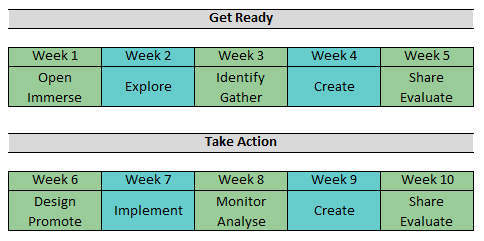 Image Attribution: Unit duration. MissE. 2018. CC-BY-NC-ND.
References
Australian Bureau of Statistics. (2013). Waste account, Australia, experimental estimates, 2013 (no.4602.0.55.005). Retrieved from http://www.abs.gov.au/ausstats/abs@.nsf/Latestproducts/4602.0.55.005Main%20Features42013?opendocuments&
European Panel on Sustainable Development. (2010). Taking children seriously – How the EU can invest in early childhood education for a sustainable future (Report No. 4 2010-12-17). Retrieved from https://www.ufn.gu.se/digitalAssets/1324/1324488_epsd_report4.pdf
Kuhlthau, C. C., Maniotes, L.K., & Caspari, A.K. (2012). Guided inquiry design: a framework for inquiry in your school. Retrieved from: https://ebookcentral.proquest.com.
Livingstone, R. (2016). Sustainability in children’s education and care. Australian Children’s Education and Care Quality Authority. Retrieved from: https://wehearyou.acecqa.gov.au/2016/01/28/sustainability-in-childrens-education-and-care