
Please note: For the purposes of this assignment, a unit plan has been created for the Get Ready mini-unit only. The unit plan includes a very brief breakdown of Take Action, but the rationale focuses solely on the inquiry learning unit plan for Get Ready.
Inquiry Learning
Inquiry and asking questions are natural. It may be trivial (what time is Coles closing?) or deeply philosophical (what is the meaning of life?). If we inquire so naturally, it makes sense to incorporate it into teaching. Inquiry learning in the classroom has many definitions, and even more names. Essentially, it is a pedagogical curriculum approach that is student-centered, authentic and stems from the genuine questions and interests of students (Lupton, 2017, Martin-Hansen, 2002).
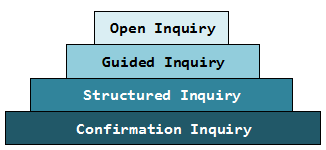 Image Attribute: Stages of inquiry. MissE. 2018. CC-BY-ND-NC. Based on Bell, Smetana & Binns, 2005.
Herron’s (1971) original research focused on the four levels of inquiry, and how at each stage the agency of the learner increases. The levels depicted by Bell, Smetana & Binns (2005) are confirmation, structured, guided and open. Whilst open inquiry is the ultimate goal, Bell, Smetana & Binns (2005) remind us that students need practice and help developing the necessary skills before they can reach successful open inquiry, “they cannot be expected to start there.” As this unit has been designed for a class of students with limited inquiry experience, the focus has been on a combination of structured and guided inquiry.
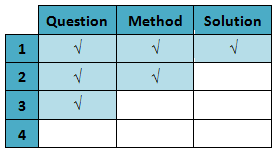 Image Attribute: Levels of inquiry. MissE. 2018. CC-BY-ND-NC. Based on Bell, Smetana & Binns, 2005.
Bell, Smetana & Binns (2005) also suggest that the complexity of an inquiry activity influences the level of inquiry which can be achieved. When students are provided with a question, a method and solution, the inquiry is limited, achieving confirmation level only. As such, this unit aims to provide a series of learning experiences that remove the method and/or solution from the teacher.
GeSTE Windows
The GeST windows – Generic, Situated and Transformative – were designed as a window “to see information literacy from different perspectives” (Lupton & Bruce, 2010). Later, the Expressive window was added. Each element of GeSTE windows has its own unique way to view information literacy and help develop stronger and deeper understandings. Through a combination of activities and questions, students in this unit will be able to consider the topic from these differing perspectives.
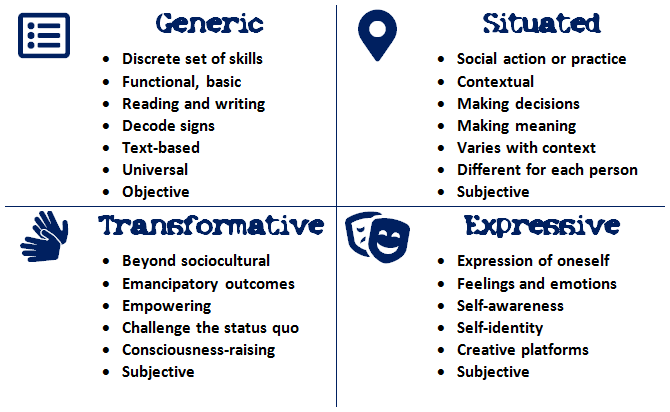 Image Attribute: Definition of GeSTE windows. MissE. 2018. CC-BY-ND-NC. Based on Lupton & Bruce, 2010 and Lupton, 2016.
Guided Inquiry Design
Frameworks are useful for guiding our teaching practices. This Geography unit – Salvaging Our Waste – has been designed to foster structured and guided inquiry through the Guided Inquiry Design model (Kuhlthau, Maniotes & Caspari, 2012), which extends from Kuhlthau’s previous research into the Information Search Process (ISP). Guided Inquiry refers to the Kuhlthau, Maniotes & Caspari’s model, whereas ‘guided inquiry’ refers to the level of inquiry. Guided Inquiry is split into eight categories: Open, Immerse, Explore, Identify, Gather, Create, Share and Evaluate, and navigate a learner through the inquiry process by addressing certain criteria at specific stages:
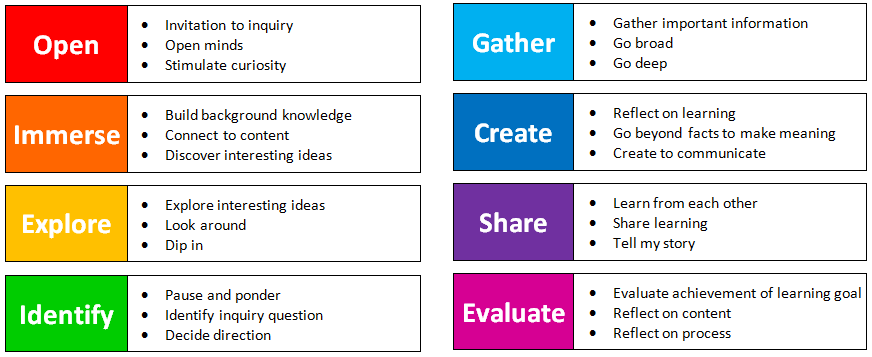 Image Attribute: Guided Inquiry Design model. MissE. 2018. CC-BY-NC-ND. Based on Kuhlthau, Maniotes & Caspari, 2012
I have used these stages to plan this unit. Whilst Guided Inquiry might appear to be a step-by-step guide, where each phase follows on, but it is not. As Cooper (2014) points out, “these phases are not purely linear and can be revisited.” Learners may go back and forth between stages, especially in the explore/identify/gather/create stages. There are opportunities to ‘create’ and ‘share’ throughout the unit, and it is expected further ‘explore’ and ‘gather’ sessions will be needed during ‘create’ to reaffirm content selection and inclusion.
Questions, and the act of questioning, are the most powerful tools we have (McKenzie, 2005) and they are critical to all stages of inquiry (Lupton, 2017). Throughout the unit, students are encouraged to ask a range of questions that allow consider different perspectives, ignite their own curiosity and fulfil the role of geographers in learning. The unit opens with an essential question:
Why are we wasting so much waste?
An essential question is neither a factual question nor a question with a correct answer, but one that invites opinions, ideas and a curiosity to discover (Wiggins, 2007). A question becomes essential when it:
- is genuine and relevant
- requires deep thought and discussion as there is no simple answer
- involves different views and perspectives
- stimulates continued re-thinking
- connects with personal experiences
- supports transferable knowledge (Wiggins, 2007).
What a question asks or investigates can determine the nature of an inquiry (Roberts, 2006, as cited in GeogSpace, 2013). This essential question combines the geographical concepts of place, space, people, environment and sustainability, putting it immediately into the situated window as it provokes inquiry into social practice and inevitably will include differing views and perspectives.
Posing a teacher-directed ‘big idea’ question at the beginning of this unit sets puts the level of inquiry initially at a lower level.
We invite inquiry through the use of the essential question and images of local landmarks filled with waste. Focusing on household waste in local, familiar environments connects students with place and space, and sets the geography inquiry in their world, beginning their situated approach to information literacy and inquiry. Local landmarks will evoke feelings in students, and these self-expressions are captured on the wonder wall and through voice clips to a class blog. Using a KWL chart, the class can construct some ideas and questions that will help support and foster more curiosity.
In immerse, we build students’ background knowledge ready for further exploration. Immerse does not need to take a long time, but give students a foundation to learn and need to inquire. Discussions at the end of the class story prompt reflection and cement knowledge gained. Students are also encouraged to write down whatever ideas of questions come into their heads. At this stage, we simply want students’ questions and ideas flowing. Prompting questions from the teacher cover generic visual literacy (what did you see?), transformative views (what was missing? Who was missing?) and elicit emotionally responses (how does it make you feel?). Social action is initiated in the homework assignment where students are encouraged to audit their home bins, making the connection between classroom learning and real life. As with open, the level of inquiry during immerse is structured.
This stage focuses heavily on situated perspectives. Students engage in fieldwork to gather authentic information through this geographical discipline approach (Lupton & Bruce, 2010), and by recording observations. Note-taking is practiced through information stations, where students also critically assess resources for credibility and bias by using the CRAP and SMELL tests. These checklists do have limitations and these should be discussed with students. Students make connections with people and perspectives through export visits and interviews. By asking questions, students will gather information from different perspectives, but need to consider the cultural, political and spiritual beliefs of their speakers to determine how and why their speakers have formed the opinions they have. Inquiry level is fluid between structured and guided.
As the inquiry moves to a more focused and driven direction, generic methods of information gathering will help support the transformative nature of the geographical inquiry. A topic party is likely to invoke discussion between students as they share ideas and information gathered. Questions they pose together may be consciousness-raising and transformative. Working in a collaborative team put students in a situated window for information sharing, as each student will have their own reasons and beliefs for sharing their selected re-search. Generic checklists and procedures like the questioning formulation technique and KWHLAQ chart will help students to create questions that will be suitable for further inquiry. The inquiry now begins to move towards the guided level as students complete the next stages.
Students will utilise steps 4-5 of Question Formulation Technique (QFT) to help finalise their question. Steps 1-3 of QFT were built into the unit plan, and Steps 6 & 7 will also be integrated:
- 1. QFocus: the assessment problem is the established focus
- 2. Rules for Producing Questions: asking as many questions as possible exactly as they are thought of, no judging, note any changes
- 3. Producing Questions: students document questions and ideas throughout open, immerse and explore
- 6. Next steps: putting questions into practice and doing re-search
- 7. Reflection: reflecting on how the work went
Now, in identify, with increased knowledge, information and ideas, students follow the remaining steps:
- 4. Categorising Questions: identify if open or closed questions, rephrase to opposite, and consider which is better
- 5. Proiritising Questions: put questions in order of interest and wish to investigate further (The Right Question Institute, n.d.)
The gather phase will require students to source their own information and resources, but will be supported with generic checklists to support initial critical evaluation, as well as study buddy sessions to help understand and comprehend re-search. ISP says students may need extra support at this stage, so study buddies provides an informal means for students to take through their problems. Emoticons in inquiry journals will also provide keys to the teacher as to whether a student requires an intervention. Re-search will be assessed for bias, currency, and with prompting questions, students will explore the situated and transformative nature of resources with questions such as:
- Who wrote the resource?
- Why did they write it?
- What information do they want me/not want me to know?
- Whose voice is/is not being heard?
- Why are those voices being silenced?
Once students have collected their resources, they can begin to analyse the information, make their own inferences and use the expressive window to share their knowledge and understanding with others. The nature of the assessment requires students to take a position and perspective, putting them in both the situated and transformative window as they use these positions to tell their story with others.
Sharing is an important part of the inquiry process. Students learn from others as they listen to their findings, and students become the teachers when they share. Presenting to others allowed students to express their thoughts and feeling on the subject.
Students now need to evaluate how their inquiry went, what questions were answered, what questions still remain, and propose new questions for future inquiries. A reflective written piece allows students to express their thoughts and feelings about the process.
ISP research found that when students struggled with the inquiry process there were strategies they naturally tried to help them move past their difficulties, such as asking others “what are you doing?” These coping strategies were further developed in the six C’s, an inquiry tool for intervene, a support for building understanding and as a structure for successful inquiry (Kuhlthau, Maniotes & Caspari, 2012). The six C’s have been incorporated in the unit to facilitate information gathering in the following ways:
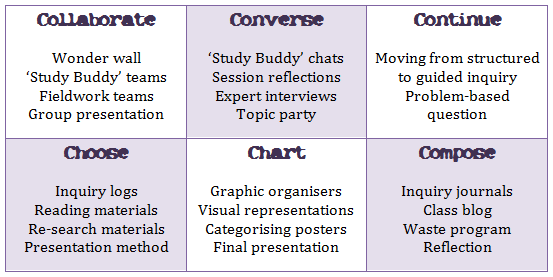 Image Attribute: 6Cs of Guided Inquiry applied to Salvaging Our Waste Unit. MissE. 2018. CC-BY-NC-ND. Based on Kuhlthau, Maniotes & Caspari, 2012
What does inquiry look like in the Geography curriculum?
The geography stages of inquiry (Australian Curriculum, Assessment and Reporting Authority ) and geography inquiry skills (NSW Education Standards Authority ) have been designed in such a way that an inquiry does not need to address all processes or all skills at once. Students can develop certain skills or process techniques through varying levels of engagement and teacher instruction. This chart shows which NSW syllabus inquiry skills are addressed at which stage of inquiry:

This unit develops the skills associated with communicating geographical information, both in Get Ready and Take Action, although each mini-unit’s focus is different. Get Ready focuses on sharing the geographical information from students’ own inquiries through creative control. Students are responsible for selecting their audience and subject matter, and creating the means with which to impart their knowledge. Whilst actions may have been proposed as part of the Get Ready conclusion, Take Action encourages students to put that knowledge into practice and instigate social action within the school community. In reflecting on the effectiveness of projects, students develop a greater understanding of geographical social action.
Acquiring geographical information takes a more teacher-centred approach, with the overarching inquiry question already set. Although students are able to develop their own inquiries within the scope of the assessment piece, the ‘problem’, as such, has already been identified. Secondary sources made available by the teaching team are, however, influenced by the journal entries and wonder wall questions of students. Opportunities to collect primary source information is offered during the explore stage. Processing geographical information takes place throughout the unit, but is done in a supported setting with teacher guidance and pair work.
This unit allows students to engage with Aboriginal and Torres Strait Islanders and question their perspectives on sustainability and the environment. Throughout the inquiry process students will need to employ critical thinking skills to evaluate sources, as well as think around the assessment problem and formulate a response. Note-taking, visual representations and reflective writing contribute to the development of discipline –specific literacy skills, whilst map reading, charting and fieldwork observations develop numeracy skills. Students will find themselves reviewing their own ethical understandings and personal responses to the social and environmental challenge of reducing household waste.
Salvaging Our Waste will hopefully equip students with the resources, knowledge and multiple perspective understanding to help them make better choices for themselves, and those around them, in regards to the war on waste.
References
Australian Curriculum, Assessment and Reporting Authority (ACARA). (n.d.). Humanities and social sciences: Geography – structure. Australian Curriculum. Retrieved from: https://www.australiancurriculum.edu.au/f-10-curriculum/humanities-and-social-sciences/geography/structure/
Bell, R.L., Smetana, L., & Binns, I. (2005). Simplifying inquiry instruction: Assessing the inquiry level of classroom activities. The Science Teacher, 72(7), 30-33.
Cooper, J. (2014). Guided inquiry by design: The story of student learning. School Library Monthly, 30(4), 18. Retrieved from: http://connection.ebscohost.com/c/articles/95832230/guided-inquiry-by-design-story-student-learning
GeogSpace. (2013). Geographical inquiry: A flexible approach. Retrieved from: https://www.geogspace.edu.au/verve/_resources/3.3.1_2_geog_inquiry.pdf
Herron, M. (1971). The Nature of Scientific Enquiry. The School Review, 79(2), 171-212. Retrieved from http://www.jstor.org
Kuhlthau, C. C., Maniotes, L.K., & Caspari, A.K. (2012). Guided inquiry design: a framework for inquiry in your school. Retrieved from: https://ebookcentral.proquest.com.
Lupton, M. (2016). Critical evaluation of information – Expressive window. Retrieved from: https://inquirylearningblog.wordpress.com/2016/07/24/critical-evaluation-of-information-expressive-window/
Lupton, M. (2017). Inquiry learning: A pedagogical and curriculum framework for information literacy. In Sales, D., & Pinto, M. (Eds.) Pathways into Information Literacy and communities of practice: Teaching approaches and case studies.
Lupton, M., & Bruce, C.S. (2010) Windows on information literacy worlds : generic, situated and transformative perspectives. In Practising Information Literacy : Bringing Theories of Learning, Practice and Information Literacy Together. Centre for Information Studies, Charles Sturt University, Wagga Wagga, N.S.W., pp. 4-27.
Martin-Hansen, L. (2002). Defining inquiry: Exploring the many types of inquiry in the science classroom. The Science Teacher, 69(2), 34-37.
McKenzie, Jamieson. (2005). Learning to question to wonder to learn. Washington: FNO Press.
NSW Education Standards Authority (NESA). (n.d.). K-10 geography syllabus: Geographical inquiry skills. https://syllabus.nesa.nsw.edu.au/hsie/geography-k10/geographical-inquiry-skills/
The Right Question Institute. (n.d.) Experiencing the Question Formulation Technique (QFT). Retrieved from: http://www.ibmidatlantic.org/Experiencing-the-QFT.pdf
Wiggins, G. (2007). What is an essential question? Big Ideas. Retrieved from: http://www.authenticeducation.org/ae_bigideas/article.lasso?artid=53