
Departing first is Question Three:
How does inquiry learning strengthen and change a primary school student’s social engagement with peers?
ProQuest accesses different thesauri depending on the selected database, which was unexpected as I believed search platforms would use a central source. I discovered that my priority concept, inquiry, is interpreted differently by ERIC and Education’s conflicting thesauri.
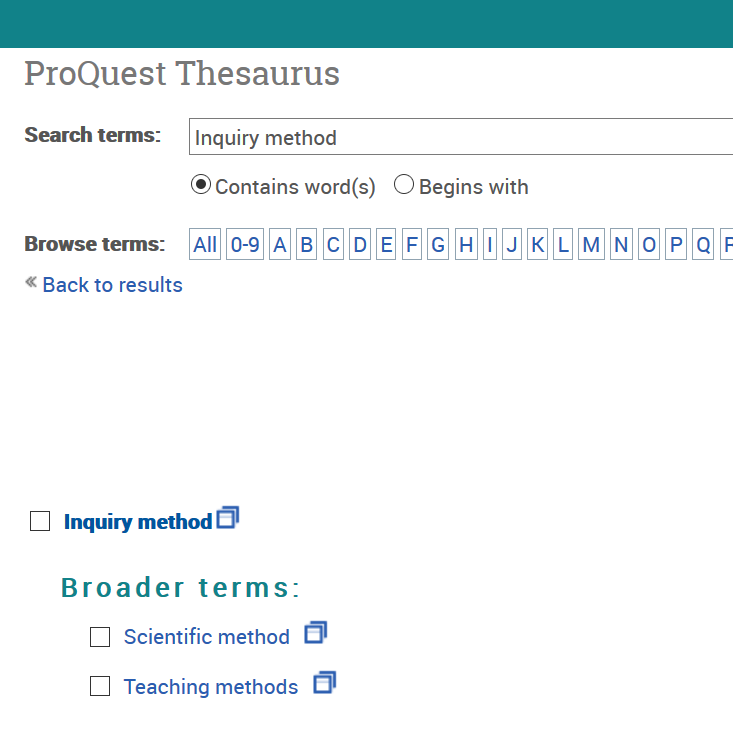 (Above) Image 5.1. Screen cap of Education thesaurus entry: inquiry |
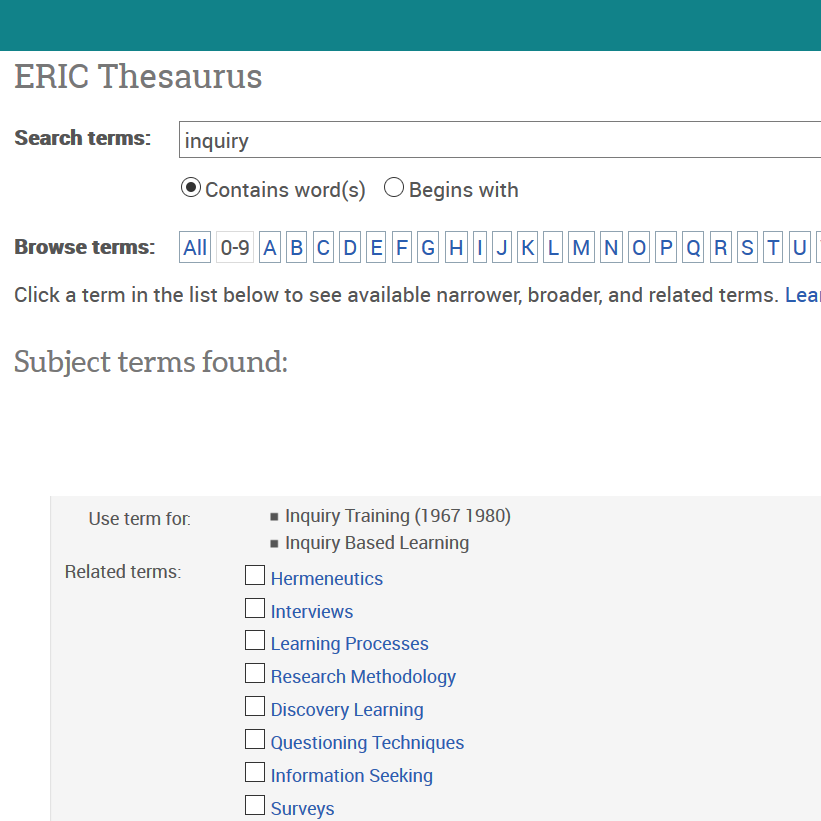 (Above) Image 5.2. Screen cap of ERIC thesaurus entry: inquiry |
In Education, inquiry focuses on the scientific method, whereas in ERIC it is inquiry-based learning, meaning results for inquiry on Education are likely to be less relevant that on ERIC. Additional thesaurus browsing on Education’s thesaurus found the term Active Learning, which better represents my question.
Knowing subject headings were more successful from A+ Education searches, I created the above string using the new thesauri entries. Six results returned, but none explored my question.
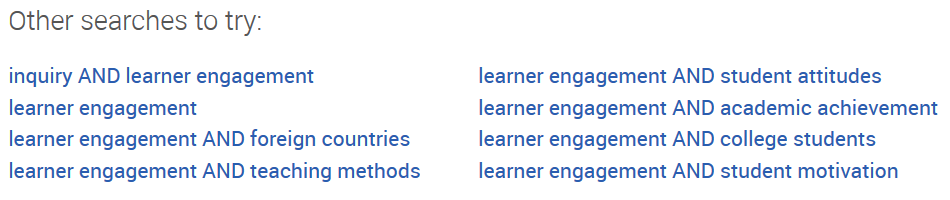
Suggested searches appear at the end of your results, and include alternative ideas and phrases. One suggestion had terminology I had not considered previously: student attitudes. I used this, and further defined the search by adding “inquiry”, then followed on with additional suggestions:
Results showed potential, but were secondary/higher education focused. I read Critical Thinking and Social Interaction in Active Learning: A Conceptual Analysis of Class Discussion from Iranian Students’ Perspective and found an interesting reference: Bringing the background to the foreground: What do classroom environments that support authentic discussions look like? Although not useful to my question, it did raise another: on:
How can you maintain authentic discussion during inquiry learning?
Although using different thesauri and subject headings, and accessing different records, the databases function the same. Sub-heading barriers was available in ERIC, but not Education, so I incorporated a complex string:
Despite producing 17,950 results, this string was one of the more fruitful searches on Education.
After countless simple and complex searches, I struggled to find appropriate results. The highly academic, scientific feel makes it frustrating to work with, as headings do not match with previous resources. Terminology appeared more scientific, and results more academic than ERIC. The complexity of results makes Education feel like the PhD candidate, whilst ERIC feels like the undergraduate.
Tip: ProQuest logs your current sessions searches and makes them available for PDF exportation!
Check out the super nerdy ProQuest ERIC and ProQuest Education searches here (ERIC) and here (EDU). Top three searches, reiterating the usefulness of subject headings in academic databases:
ProQuest ERIC is your Business class of the flight world, with ProQuest Education clinching First class. Both systems require subscription/registration before anything can be accessed. Once inside the exclusive lounge, search and filter facilities exceed those available through A+ Education. Results are primarily peer-reviewed or academic journal articles. ProQuest Education’s academic and peer-reviewed journal results provide First class information, whilst ProQuest ERIC maintains the high academic standards of ProQuest Education, but provides some lighter, easier-to-read articles as well.
– – – – – – – – – –